


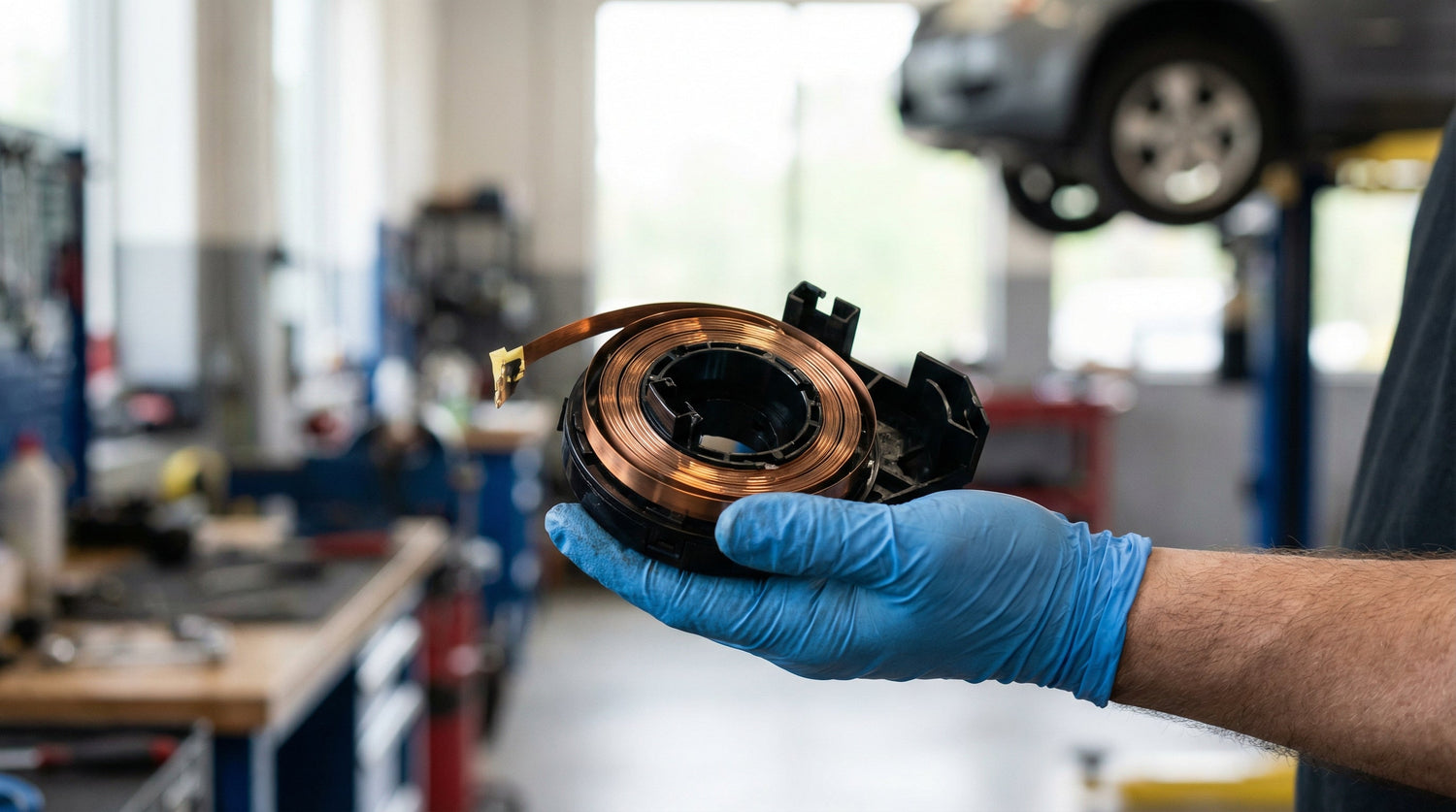
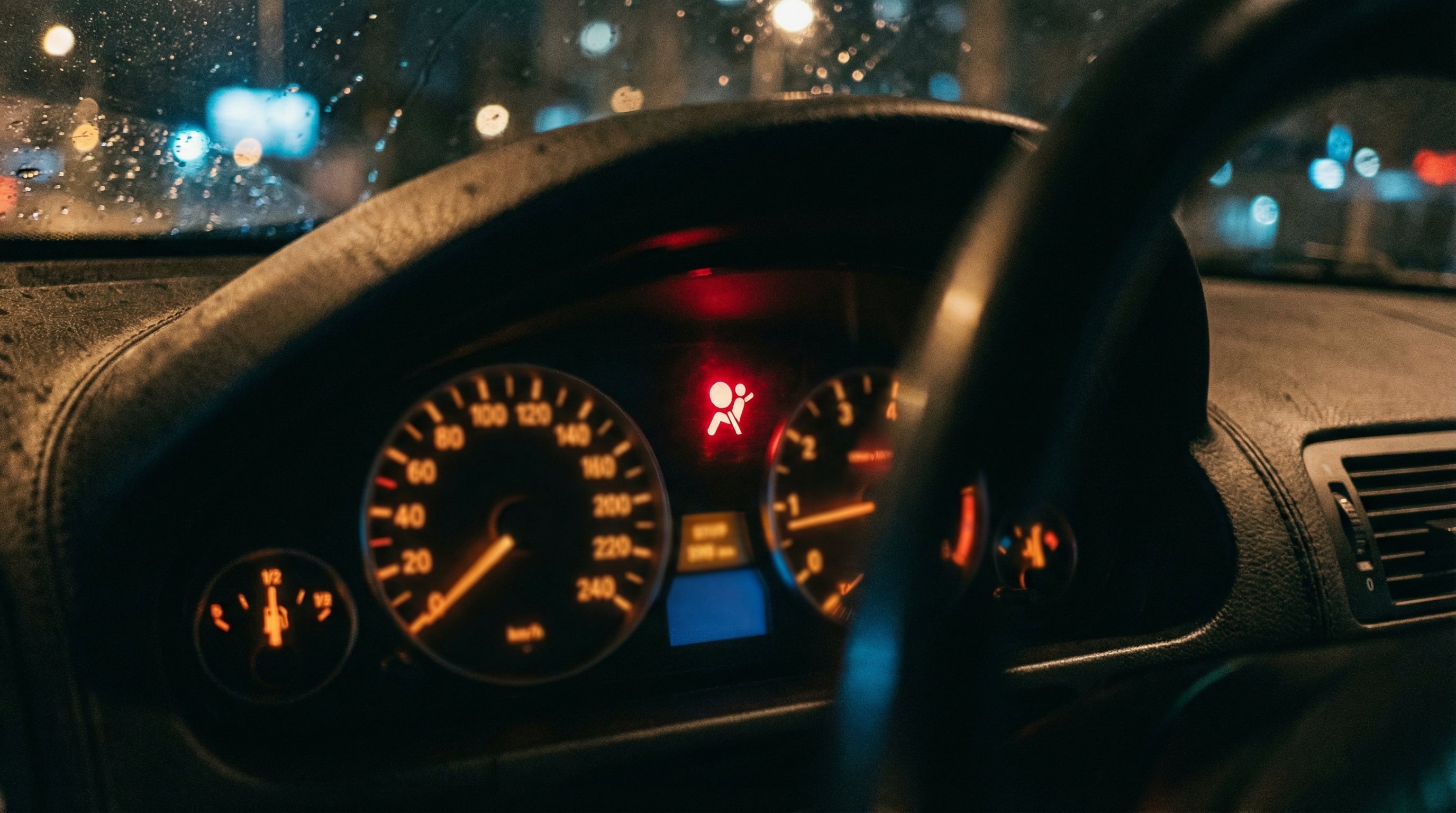
If your horn suddenly stops working, your airbag warning light comes on, or your cruise control buttons go dead — all at the same time — there's a good chance your clock spring has failed. It's one of the most misunderstood parts in your steering column, and one of the most important. A broken clock spring doesn't just kill your horn. It can disable your airbag system entirely, putting you at serious risk in a collision.
In this guide, we'll walk you through every clock spring failure symptom to watch for, what it typically costs to replace one in 2025, and how the repair process works — including a smarter option most shops won't tell you about when a collision has already damaged your collapsible steering column sensor.
What Is a Clock Spring (and Why Does It Fail)?
The clock spring — also called a spiral cable, coil assembly, or contact reel — is a flat, ribbon-like electrical connector that lives inside your steering column, between the steering wheel and the column itself. Its job is to maintain a continuous electrical connection between your fixed wiring harness and your rotating steering wheel, no matter which direction you turn.
Without it, your steering wheel-mounted controls would have nowhere to connect. That means your horn, airbag, cruise control buttons, audio controls, and phone controls all run through this one small coil. When it fails, those systems fail with it.
Why do clock springs fail? There are three main causes:
- Normal wear over time. The clock spring flexes thousands of times per year with every steering input. Over 100,000+ miles, the internal ribbon cable can crack or break from simple fatigue.
- Moisture intrusion. Some clock springs are not fully sealed. If moisture gets inside — from a leak or high humidity — it can corrode the contacts and cause intermittent or complete failure.
- Collision damage. Even a moderate impact can physically damage the clock spring or trigger deployment of connected airbag components, requiring full replacement of the assembly.
Clock springs are also sometimes recalled on specific vehicles. If you're experiencing symptoms, it's worth running your VIN through the NHTSA recall database before spending money on parts.
6 Symptoms of a Failing Clock Spring
Clock spring symptoms often come on gradually — one system acting up, then another. Here's what to look for, in order of how commonly they appear:
1. Airbag or SRS Warning Light
This is the most critical symptom. When the clock spring's connection to the airbag circuit breaks, the Supplemental Restraint System (SRS) module detects an open circuit and illuminates the airbag warning light on your dash. A lit airbag light means your airbag may not deploy in a crash. Do not ignore this symptom. Have it scanned for fault codes immediately — common codes include B1317, B1318, or airbag-specific codes depending on your vehicle make.
2. Horn Stops Working
The horn circuit runs through the clock spring. If your horn suddenly goes silent — or only works when the wheel is in a specific position — suspect the clock spring before anything else. This is often the first mechanical symptom people notice because it happens outside of warning lights.
3. Cruise Control Won't Set or Disengages Randomly
Your cruise control buttons on the steering wheel communicate through the clock spring. A failing clock spring can cause the system to refuse to engage, disengage without input, or fail to respond when you press the buttons. This symptom is especially dangerous on highway driving.
4. Steering Wheel Audio and Phone Controls Stop Working
Modern vehicles have volume, track, and call controls built into the steering wheel. When the clock spring fails, these go dark. You may notice they stop working entirely or behave erratically — pressing "volume up" changes tracks, for example.
5. Intermittent Electrical Behavior in the Steering Column
Before a full failure, you may notice that systems cut in and out depending on steering wheel position. The horn works when the wheel is straight but not when turned. Cruise sets sometimes but not others. This is a classic sign of a ribbon cable that has partially cracked but hasn't fully broken yet.
6. Fuses Blowing Repeatedly
In some cases, a shorted clock spring ribbon cable can cause fuses to blow repeatedly for the horn or airbag circuit. If you find yourself replacing the same fuse more than once, a clock spring short may be the root cause.
Clock Spring Replacement Cost: What to Expect in 2025
According to RepairPal's national data, the average cost to replace a clock spring (airbag clockspring) runs between $507 and $563 at an independent shop, with labor accounting for $120–$176 of that total and the part itself averaging around $387.
However, those numbers vary significantly by vehicle. Here's a realistic breakdown:
| Cost Tier | Parts Range | Labor Range | Total Estimate | Typical Scenario |
|---|---|---|---|---|
| Budget | $30–$100 | $70–$120 | $100–$220 | Older domestic vehicles, aftermarket parts |
| Mid-Range | $150–$400 | $100–$175 | $250–$575 | Most late-model domestic and Asian vehicles, OEM parts |
| Premium | $400–$700+ | $130–$250 | $530–$950+ | European vehicles, trucks, luxury makes (Ram 1500, BMW, Mercedes) |
Dealer vs. independent shop: Dealers will typically charge 20–40% more for both parts and labor. An independent shop or specialized post-collision repair service will almost always be the more cost-effective route — especially for clock spring work, which is a straightforward R&R job on most vehicles.
What Affects the Price Most?
- Vehicle make and model. European vehicles (BMW, Mercedes, Audi) and full-size trucks command higher parts costs. A Kia Forte clock spring part may cost $135; a Ram 1500's may cost $663 for the same labor time.
- OEM vs. aftermarket parts. OEM clock springs are more reliable but cost more. For safety-critical components connected to your airbag system, OEM or OEM-equivalent is the right call.
- Whether the airbag deployed. If you're dealing with post-collision repair and the airbag went off, the clock spring replacement is just one piece of a larger SRS rebuild — which leads us to the component most people don't know about.
The Part Most Shops Miss: The Collapsible Steering Column Sensor
If your vehicle was in a collision and the airbags deployed, there's a second steering column component that almost certainly needs attention — and most body shops either miss it or recommend a $1,500+ dealer steering column assembly replacement when it's not necessary.
The collapsible steering column sensor (also called the pyrotechnic sensor or collapsible stage sensor) is a small device embedded in your steering column. In a crash, it fires — allowing the steering column to collapse inward by about an inch, protecting the driver's chest from impact. Once it fires, it's spent. The SRS module records this as a fault (often DTC code B0005) and the airbag system will not function correctly again until it's addressed.
The problem? Dealerships typically don't sell this sensor as a standalone part. They sell you the entire steering column assembly — which can cost $1,000–$2,500 or more in parts alone, plus several hours of labor.
The smarter solution is collapsible steering column sensor repair — a rebuild service where the spent pyrotechnic sensor is extracted and professionally repaired or replaced at a fraction of the cost. At LND Solutions, we specialize in exactly this: our collapsible steering column sensor repair service saves customers hundreds compared to dealer pricing, with fast turnaround and guaranteed results.
If your post-collision repair estimate includes a full steering column replacement, get a second opinion. You may only need the sensor repaired.
How to Replace a Clock Spring: Step-by-Step Overview
Clock spring replacement is a DIY-possible job for mechanically confident owners on most vehicles. It requires basic hand tools, a torque wrench, and careful attention to the airbag system safety procedures. Here's how it works:
Step 1: Disconnect the Battery and Wait
Before touching anything near the steering column, disconnect the negative battery terminal and wait at least 15–30 minutes. This allows the airbag system's backup capacitor to discharge. Skipping this step risks accidentally deploying the airbag — a $1,000+ mistake and a serious safety hazard.
Step 2: Remove the Steering Wheel
With the wheels pointed straight ahead, remove the airbag module from the steering wheel center (usually secured by two bolts or torx screws accessed from the back of the wheel). Disconnect the airbag and horn connectors carefully. Then remove the steering wheel nut and pull the wheel using a proper puller — never hammer it off.
Step 3: Note the Clock Spring's Center Position
This is the most critical step. The clock spring must be installed in its centered position, aligned with the wheels pointed straight ahead. Most new clock springs ship pre-centered (locked with a plastic tab). If yours doesn't, center it manually by turning it slowly in both directions to find the midpoint, then position it there before installation.
Step 4: Remove the Old Clock Spring
Disconnect all the electrical connectors (horn, airbag, cruise control, audio). The clock spring typically snaps or screws onto the steering column. Remove it and compare it to the new unit before proceeding.
Step 5: Install the New Clock Spring
Connect all the wiring harness connectors to the new unit before mounting it — it's much easier to plug in first. Secure the clock spring to the column, then reinstall the steering wheel, torquing the center nut to manufacturer spec (typically 35–40 ft-lbs, but check your service manual).
Step 6: Reinstall the Airbag and Reconnect the Battery
Reconnect the airbag connector, seat the airbag module back into the steering wheel, and tighten the retaining screws. Reconnect the battery. Turn the key to the ON position (do not start) and verify the airbag light clears after a few seconds. If it stays on, a fault code scan is needed to identify the remaining issue.
When to Call a Pro Instead
If the airbag light was on before the clock spring failed, if you're dealing with post-collision SRS reset work, or if your vehicle is still under warranty, a professional shop is the right call. Airbag system work has zero margin for error — a system that appears to work but has a hidden fault can fail to deploy when you need it most.
Clock Spring vs. Collapsible Steering Column Sensor: Which Do You Need?
These two parts are often confused — and sometimes both need attention after a collision. Here's a quick comparison:
| Component | What It Does | Fails When | Typical Cost to Fix |
|---|---|---|---|
| Clock Spring | Routes electrical signals from steering wheel to vehicle | Wear, moisture, collision, age | $100–$950 (parts + labor) |
| Collapsible Steering Column Sensor | Pyrotechnic device that allows column to collapse in crash | After any crash that deploys airbags | $200–$600 via repair service vs. $1,000–$2,500+ for full column replacement |
If you're diagnosing a non-collision issue (horn stopped, airbag light on, cruise control dead), start with the clock spring. If you're rebuilding after a crash, the collapsible steering column sensor is the component you need to address alongside the airbag module and seat belt pretensioners.
Is It Safe to Drive with a Bad Clock Spring?
The short answer: it depends on which systems are affected — but you should treat any clock spring failure as urgent.
If your airbag warning light is on due to a clock spring fault, your supplemental restraint system is compromised. In a collision, your airbag may not deploy at all. That's not a minor inconvenience — it's the difference between walking away and a serious injury. No mechanic will tell you that's a risk worth taking.
If your horn is simply out but the airbag light is off, the risk is lower but you're still driving an illegally equipped vehicle in most states (functioning horns are required by law). Beyond the legal issue, losing cruise control on highway driving is a real distraction hazard.
Our recommendation: get a fault code scan as soon as any of the symptoms in this article appear. The scan tells you exactly which circuit has failed and whether your airbag system is fully functional. Most auto parts stores (AutoZone, O'Reilly, Advance Auto) offer free OBD2 scanning, though SRS-specific codes often require a more capable scanner.
Expert Takeaways: What We See in Post-Collision Repair
After working on airbag and SRS systems across thousands of vehicles, a few patterns stand out consistently:
- The clock spring is one of the most commonly overlooked parts in a post-collision SRS rebuild. Body shops focus on the visible damage — airbag modules, seat belt pretensioners — and sometimes miss the clock spring or collapsible column sensor entirely, leaving the SRS light on and the customer frustrated.
- Dealer replacement quotes are almost always overkill for collapsible steering column sensors. Because the sensor isn't sold separately, dealers quote the full column assembly. A repair service costs a fraction of that and restores the same function.
- A properly reset SRS system is non-negotiable after any airbag deployment. It's not enough to clear codes with a scanner. Every component — airbag module, clock spring, collapsible sensor, pretensioners — needs to be inspected and addressed before the system will arm correctly again.
- Not all clock springs are created equal. Aftermarket clock springs have a higher failure rate on safety-critical applications. For anything connected to your airbag circuit, use OEM or OEM-equivalent parts.
If your vehicle has been in a collision and you're dealing with an SRS light that won't clear, our team can help. We specialize in the components most shops struggle to source — including collapsible steering column sensor repair that saves you from an unnecessary full column replacement.
Bottom Line
A failing clock spring isn't a problem you can ignore or work around. It sits at the intersection of your horn, your airbag, and your steering wheel controls — and when it goes, it takes all three with it. The repair is straightforward and relatively affordable compared to the risk of driving with a compromised SRS system.
For routine clock spring failures on a vehicle that hasn't been in a collision, expect to pay $250–$575 at an independent shop for most domestic and Asian vehicles, with European and truck platforms running higher. The job takes 1–2 hours for most technicians and is DIY-friendly for confident owners who respect airbag safety protocols.
For post-collision repairs, don't let a dealer talk you into a $2,000+ steering column replacement before getting a second opinion. The collapsible steering column sensor can often be repaired for a fraction of the cost — and our steering column sensor repair service at LND Solutions is specifically designed for exactly that situation.
Need your clock spring or collapsible steering column sensor repaired?
LND Solutions specializes in post-collision SRS component repair — including collapsible steering column sensors that dealers won't sell separately. Save hundreds compared to full column replacement with our fast-turnaround repair service.

Leave a comment
This site is protected by hCaptcha and the hCaptcha Privacy Policy and Terms of Service apply.